On almost every spec, an iPhone beats a 2000s digicam. A typical 2005 compact, Canon's PowerShot SD400, takes 5.0-megapixel photos and 640×480 video; an iPhone 17 has a 48MP main camera, 4K video and Night mode. The digicam wins on character: a strong built-in flash, simple processing and no notifications. So the iPhone is the better camera, but the digicam often makes the picture people actually want: flash-lit, soft and warm.
Key takeaways
- iPhone 17 and iPhone 17 Pro win on detail, low light, video and zoom range.
- Many vintage compacts have smaller sensors than current phones and take less sharp pictures, NPR notes.
- The digicam's edge is its flash and its plain processing. A phone "flash" is closer to an LED flashlight.
- Which looks better is taste, not a spec. Many young people find iPhone photos "a little too real."
- Try the free route first: set the iPhone flash to On and shoot in 4:3.
The two cameras in this comparison
For the digicam, we picked the Canon PowerShot SD400 Digital ELPH, sold as the Digital IXUS 50 in Europe and Asia and marketed from March 2005. It is a pocket compact with a 5.0-megapixel CCD sensor and a 3x zoom, the kind of camera people now dig out of drawers (Canon Camera Museum). For the phone, iPhone 17 and iPhone 17 Pro, with figures from Apple's tech specs (Apple, Apple).
| Canon PowerShot SD400 (2005) | iPhone 17 | iPhone 17 Pro | |
|---|---|---|---|
| Main camera | 5.0 MP, 1/2.5-inch CCD | 48MP Fusion Main | 48MP Fusion Main |
| Sensor size | 1/2.5 inch | Not listed by Apple | Not listed by Apple |
| Lenses (35 mm equivalent) | 35–105 mm zoom, f/2.8–4.9 | 26 mm f/1.6 main, 13 mm ultra wide, 52 mm 2x | 24 mm f/1.78 main, 13 mm ultra wide, 100 mm 4x |
| Flash | Built-in, 50 cm–3.5 m at wide | True Tone flash | Adaptive True Tone flash |
| Processing | DIGIC II | Photonic Engine, Deep Fusion, Smart HDR 5 | Photonic Engine, Deep Fusion, Smart HDR 5 |
| Low light | ISO up to 400, Night snapshot scene | Night mode | Night mode |
| Photo formats | JPEG | HEIF and JPEG | HEIF, JPEG and DNG |
| Video | 640×480 at up to 30 fps | 4K Dolby Vision up to 60 fps | 4K Dolby Vision up to 120 fps |
| Power | NB-4L lithium-ion pack | Built-in battery | Built-in battery |
| Weight | About 130 g (body) | 177 g | 206 g |
Sensor, resolution and lens
The SD400's largest photo is 2592×1944 pixels. The iPhone's main camera supports 24MP and 48MP photos. That is a lot more detail to crop into.
Sensor size is harder to compare, because Apple doesn't list it. NPR had to correct a story on this point: "Many vintage digital compact cameras actually have smaller sensors than current smartphone cameras and produce less sharp and detailed images" (NPR). The sensor type differs too: CCD then, CMOS now. Our CCD vs CMOS guide explains what that does and doesn't change.
The lens tells the same story. The New York Times noted that older cameras have "fewer megapixels, which capture less detail, and built-in lenses with higher apertures, which let in less light" (The New York Times, via DT Next). A lower f-number means a wider opening: the SD400 opens to f/2.8, the iPhone 17 main camera to f/1.6. The digicam does start tighter, though. Its widest view is 35 mm, while the iPhone's main camera is 26 mm (24 mm on the Pro), so the phone fits more of the room in.
Flash: where the digicam wins
This is the big one. A phone's "flash" is "more of an LED flashlight than a real xenon flash tube," and far less powerful than a compact's built-in flash (Digital Camera World). Canon rated the SD400's flash for 50 cm to 3.5 m (1.6 to 11.5 ft) at the wide end, and you could force it on with a "flash on" setting.
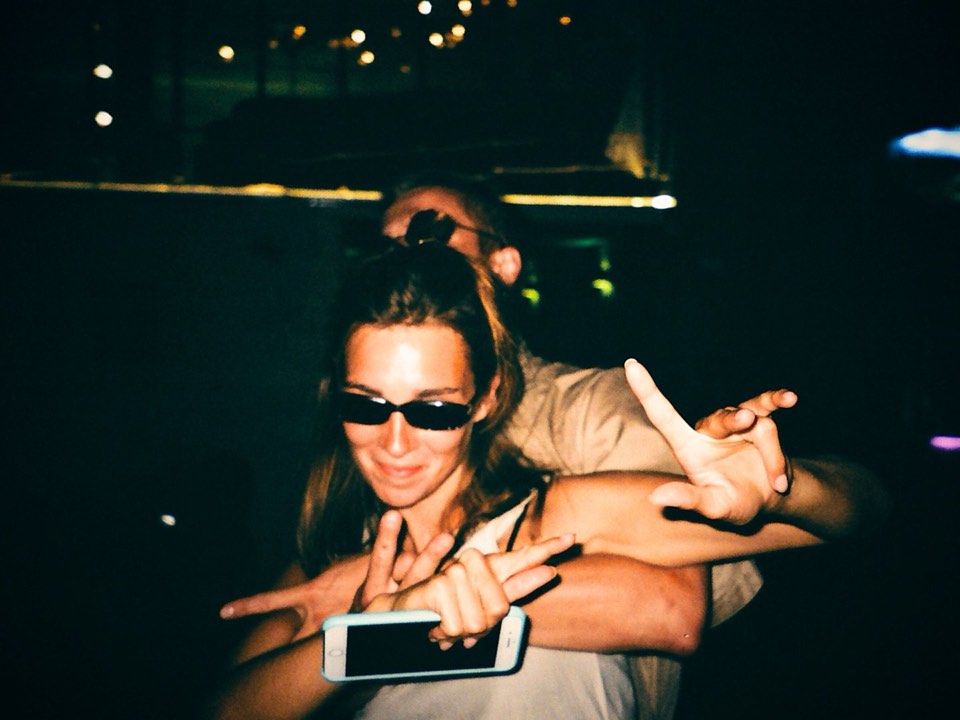
Shoot a friend a few feet away at night with that flash and the face goes bright and flat while the background falls into black. Trend reporter Elizabeth Gulino told NPR that digital camera flash gives photos an "airy, floaty and ethereal" look compared with a smartphone flash.

Processing: why iPhone photos look "too real"
The SD400 used Canon's DIGIC II engine, built "for high-definition images and fast data processing." The iPhone 17 lists Photonic Engine, Deep Fusion and Smart HDR 5. Digital Camera World puts it simply: between HDR, portrait blur and heavy low-light processing, phone photos are "part camera, part algorithm" (Digital Camera World).
Not everyone wants that. "There's so much processing that goes on in your phone that you don't have any control over," photographer Casey Fatchett told NPR. Gwen Coyne said in another NPR story, "I feel like iPhone cameras look just so... sometimes it looks a little too real" (NPR). Sofia Lee of the @digicam.love community told CBC an old camera's photo goes through "a significantly more primitive set of algorithmic transformations" (CBC News). Whether that looks better is taste, not fact.
Low light and video
Without flash in a dark room, the iPhone wins easily. On supported models, Night mode "automatically brightens photos and captures more detail in low light," and turns on by itself when it's dark (Apple). It is also what makes the iPhone good at Christmas lights. The SD400 tops out at ISO 400 and has a Night snapshot scene, so in the dark it leans on its flash.
Video isn't close. The SD400 records 640×480 at up to 30 fps. The iPhone 17 records 4K Dolby Vision at up to 60 fps, and the iPhone 17 Pro up to 120 fps on its main camera.
Convenience
The iPhone is already in your pocket and can share a photo the moment you take it. A digicam needs its own battery and charger, a memory card, and a trip to a computer or card reader. Here is how to get photos from a digital camera to iPhone. But the phone also brings notifications. "I'm pulling out my phone to take a photo and then I see a notification or I'm checking my email," wedding photographer Christina Berkett told NPR.
Many people just use both. Jaden Williams, 16, told NPR he uses his phone for food photos, "but if I'm out with friends or at a party, I might use the camera for a more, like, warm vibe."

Verdict: when the worse camera wins
- Use the iPhone for detail, landscapes, zoom, dark rooms without flash, video, and anything you need to share right away.
- Use a digicam for flash portraits at night, parties, and photos that feel like a memory rather than a record. You also get a camera that can't ping you.
The New York Times summed up the trend: "This time, the poor picture quality isn't for lack of a better tool. It's on purpose." Before buying, try the free route. In the Camera app, tap the Flash control and switch it to On, then pick the 4:3 aspect ratio (Apple). Our digicam look guide goes further, and why digital cameras are popular again covers the trend.
If you want the look without a second device, DCIM's COVER gives the look of a 2006 compact with a strong direct flash, the Z-9 is built for after dark, and the S-500 gives warm 2005 color. It can't swap your iPhone's flash for a xenon tube; it gives you the look of one.
FAQ
Is a digital camera better than an iPhone?
A 2000s digicam is not. iPhone 17 beats it on resolution, low light, video and lens range. A digicam is better only at its look: strong flash and simpler processing.
Why do digicam pictures look different from iPhone pictures?
A stronger built-in flash, a less sharp lens, fewer megapixels and much simpler processing. The iPhone adds features like Deep Fusion and Smart HDR 5.
Digital camera vs iPhone 17 Pro: which should I use?
For detail, zoom (up to its 100 mm 4x Telephoto), low light and 4K video, the iPhone 17 Pro. For flash-lit party photos with a 2000s feel, an old digicam or a digicam-style camera app.
Do old digital cameras have bigger sensors than iPhones?
Usually not. NPR notes that many vintage compacts have smaller sensors than current smartphone cameras. Apple doesn't list the iPhone's sensor size in its tech specs.
Can an iPhone take digicam-style pictures?
Partly. Set the flash to On and shoot in 4:3. The LED flash and processing still look like an iPhone, which is why some people use a digicam-style app.
Sources
- Canon Camera Museum. PowerShot SD400 DIGITAL ELPH. Accessed November 22, 2026.
- Apple. iPhone 17 - Tech Specs. Accessed November 22, 2026.
- Apple. iPhone 17 Pro - Tech Specs. Accessed November 22, 2026.
- Apple. Take Night mode photos with your iPhone camera. iPhone User Guide. Accessed November 22, 2026.
- Apple. Use iPhone camera tools to set up your shot. iPhone User Guide. Accessed November 22, 2026.
- Claire Murashima, NPR. Digital cameras are back. Here's what to look for when buying one. December 10, 2024. Accessed November 22, 2026.
- Alina Selyukh, NPR. The 2000s digital camera is cool again. Here's why. July 18, 2026. Accessed November 22, 2026.
- Kalley Huang, The New York Times, republished by DT Next. The hottest Gen Z gadget: A 20-year-old digital camera. January 10, 2023. Accessed November 22, 2026.
- Lily Dupuis, CBC News. Why Gen Z is sparking a digital camera renaissance. December 25, 2024. Accessed November 22, 2026.
- Hillary K. Grigonis, Digital Camera World. The compact camera comeback isn't about nostalgia. 6 surprising reasons Gen Z is bringing back point-and-shoots. January 6, 2025. Accessed November 22, 2026.